
This Isn’t Another Cycle in Direct Selling. It’s a Separation - Part 1
By Gregg Corella - General Manager, Direct Selling Channel at Ordergroove

Thank you for reading The World of Direct Selling. You can upgrade to a paid subscription here. You’ll receive weekly articles that are exclusively available to our paid subscribers, as well as weekly industry news roundups. You will also have full access to our article archive.
Yearly plan is 40% off now!
I’ve been in this channel long enough to have watched it reinvent itself several times. I’ve seen the boom years, the regulatory cycles, the consolidation waves, the pivots that worked and the ones that didn’t. So, when I tell you that what I’m watching right now feels structurally different — not cyclically different — I want you to take that seriously. These are my takeaways from the conversations on and off stage at Spring DSU 2026.
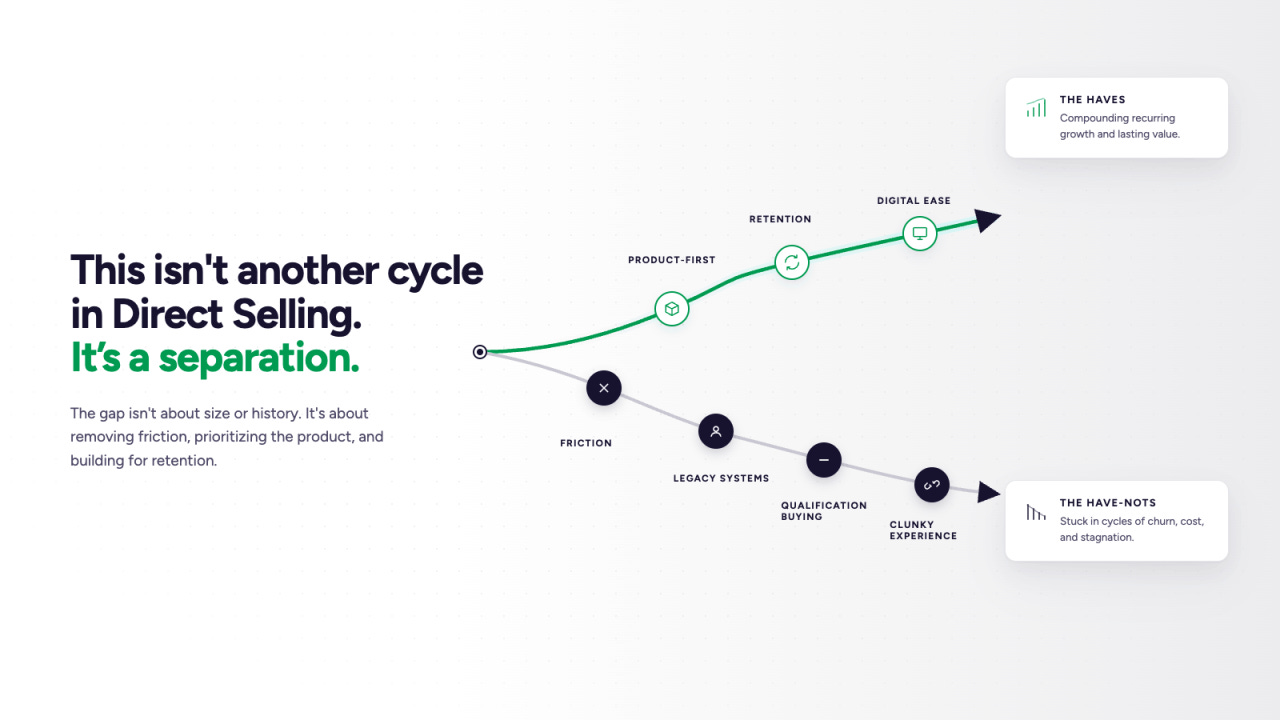
Stuart Johnson’s keynote gave us the data to back up what a lot of us have been feeling. Half the companies in the product category are in real momentum. The other half are down considerably. Stuart called it a “distributed curve of haves and have-nots.” I’ve been thinking about that framing ever since. After 35 years of watching these cycles, it’s becoming clear that the gap isn’t created by how hard the field is working, but by how much friction the model is forcing them to overcome.
The Defining Characteristic Is Honesty — With Yourself
The “haves” right now aren’t necessarily the biggest companies or the oldest brands. What they have in common is that they got honest with themselves early enough to actually do something about it.
Honest about their friction. Honest about whether their product could sell without a business plan attached to it. Honest about whether their customers were buying because the product worked or because qualifying volume demanded it.
I got my start as a Nu Skin distributor in the early 90s, under some of the best leaders I’ve ever seen in this business — Nathan Ricks, Clara McDermott, Dr. Jack Pfeifer. I still use Nu Skin products today. Not because anyone’s paying me to. Not because I’m chasing a check. Because the products work. That experience shaped how I evaluate everything in this channel: are there real customers — beyond qualification-driven purchasing behavior — who reorder consistently because the product actually works in their life?
That question has never mattered more than it does right now.
The “have-nots” are the companies that are still making their customers jump through hoops to reorder, still leading with the business opportunity before the product has proven itself, still operating on legacy systems that haven’t kept pace with modern consumer expectations. In a world where every alternative is one tap away, that’s not an inconvenience. That’s a dealbreaker.
The FTC Isn’t the Problem. The Problem Is the Problem.
Stuart walked through the Forever Living situation at DSU — the FTC pressure, the decision to pivot out of U.S. direct selling entirely. A lot of people in this channel want to frame that as regulatory overreach.
My take: if the narrative is controlling you, you probably contributed to it. In many cases, those income claims existed long before regulators documented them.
The companies making progress are focusing less on the narrative and more on improving what’s happening in the field. The companies that aren’t in the FTC’s crosshairs right now have something in common — their customers buy because the product works, many of them on continuity or subscription, and the business opportunity is presented honestly. That’s not a communications strategy. That’s just running a legitimate business.
The Field-to-Digital Gap Is Where Most Companies Are Bleeding Out
Here’s something I don’t think gets talked about enough: the single biggest structural weakness in the product category right now isn’t the product. It’s the gap between what a great field leader can do in a one-on-one conversation and what actually happens after that conversation ends.
A representative can build genuine trust with a customer. They can answer questions, share their personal story, address hesitations, and close the sale. That human interaction is still our most powerful asset — it always has been. But then what? The customer has to navigate a clunky website to set up a subscription. The reorder process has friction. The rep has no visibility into whether that customer actually came back. The relationship that took weeks to build gets lost in a commerce experience that belongs in a different decade.
This is the Field-to-Digital gap. And it’s killing retention.
The companies starting to win in recurring revenue are the ones treating their field as relationship builders who initiate demand supported by a digitized replenishment system — not as a replacement for one. The rep starts the relationship. The technology sustains it. When a customer’s reorder becomes automatic and effortless, they stop being a one-time buyer and starts becoming a long-term subscriber. That’s when the economics of this model actually work the way they’re supposed to.
What Ordergroove’s CEO Greg Alvo calls “relationship commerce” is exactly this idea: the trust and human connection that direct selling has always been built on becomes the engine of the actual transaction — across platforms, at scale, on subscription. The rep digitizes the interaction. The platform automates the replenishment. The company builds a recurring revenue asset instead of a leaky bucket.
This is not a technology problem. It’s a strategic decision about whether you’re building a durable business or operating transactionally.
…..
This article was originally published by Gregg Corella on LinkedIn. Republished with permission.
We will continue with the second part of the article next week with Gregg’s recommendations on this subject.

A short selection of headlines from our weekly news roundup below:
Natura: 6% of its stock now owned by a private equity company
Vorwerk: Integrating its operations in Romania
Tupperware: Returning to Australia and New Zealand
Upgrade to get access to these and to all other important direct selling news:
Leadership Unplugged: Ryan Rogers, CEO of Mary Kay
We have been conducting a series of Q&As with executives on The World of Direct Selling that we call “Leadership Unplugged”. Here, we engage with direct selling executives to share their personal insights and experiences. This initiative aims to provide our readers with a more intimate understanding of the leaders in our industry.
This part features Ryan Rogers. Ryan’s first role at Mary Kay was Financial Analyst and he held several positions after that. In 2013, he became Chief Investment Officer, and in 2023, Chief Executive Officer.